
The Soviet Union built millions of apartments, and huge numbers of families moved from communal apartments, barracks and severely overcrowded housing into separate flats. But the modern claim that “everyone in the USSR was given a free apartment” is a much simpler version of a far more complicated reality.
Housing was provided through the state, municipalities and state enterprises. People could not simply choose an apartment on the open market, and many families had to wait for years before they received one.
The apartment really was almost free
One of the defining features of the Soviet housing system was that a large share of housing was distributed by the state, local authorities or state-owned enterprises. Residents did not have to buy these apartments at market prices, and rents were extremely low.
So there is a real basis for saying that housing in the USSR was “free.” But that did not mean that any citizen could walk into a government office and receive whichever apartment they wanted.
The World Bank described Soviet housing as being provided practically free of charge and as an important social benefit. At the same time, the system was associated with chronic housing shortages, long waiting lists and problems with housing quality and maintenance.
Free did not mean immediate
The fact that housing was provided without a market purchase price did not mean that people received it immediately.
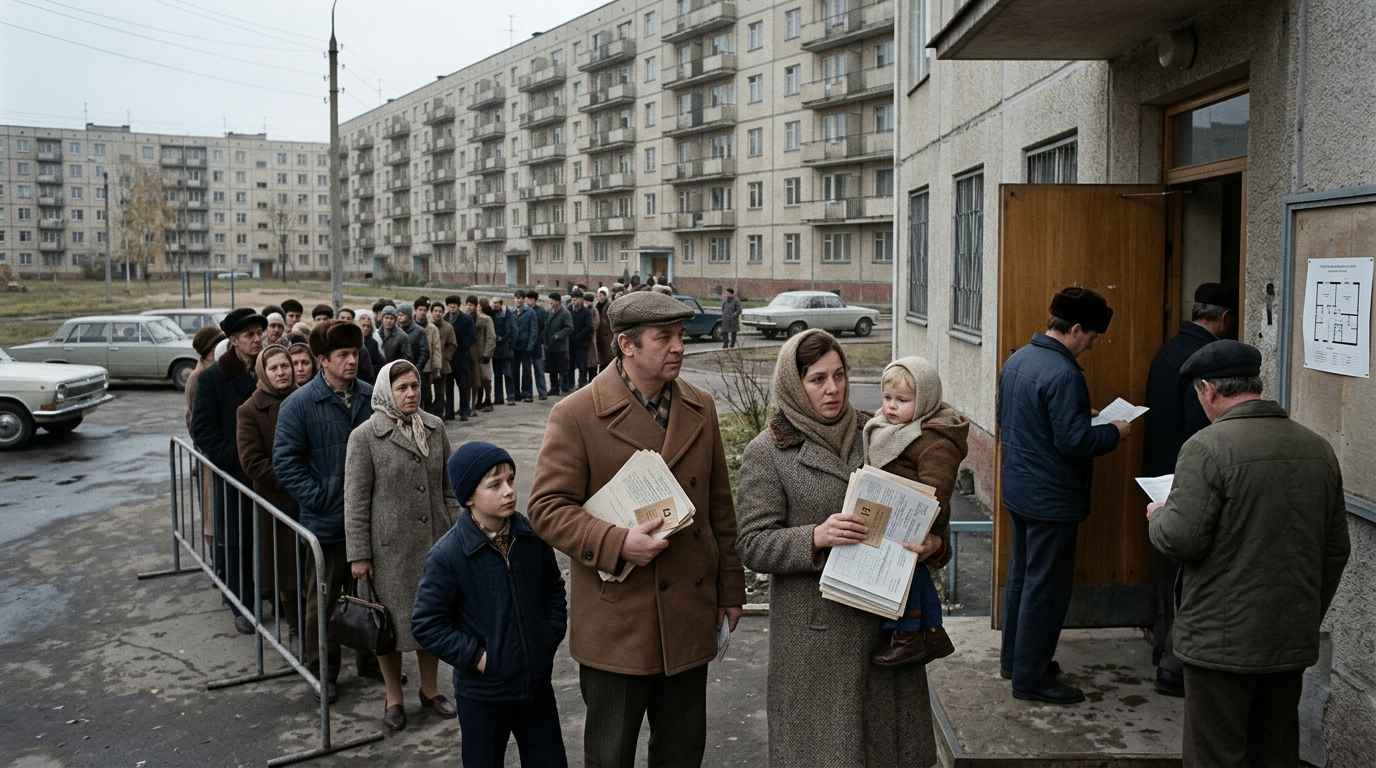
Citizens who were considered to need better housing were registered and placed on waiting lists. Soviet regulations, including the 1984 RSFSR rules, established procedures for registering people in need of improved housing and allocating apartments. Housing was generally provided according to the order in which people had been registered, while separate categories received priority or extraordinary access.
In other words, the basic process was roughly this: a person first had to qualify as being in need of better housing, then be placed on a waiting list, and only later could they receive an apartment when their turn came.
Why were there housing queues?
The central contradiction was simple: housing was treated as a state responsibility, but the supply was not large enough to satisfy demand immediately.
As a result, enormous waiting lists developed. World Bank data on Soviet cities in 1988 show that the number of families and individuals waiting for housing reached tens of thousands and, in some cities, hundreds of thousands. Moscow had roughly 345,000 families and individuals on the waiting list, while Leningrad had about 283,000 and Novosibirsk more than 112,000.
Not everyone was automatically entitled to join the queue. Housing-space norms determined who could be officially recognized as needing improved living conditions. People whose living space per person fell below the established standards could qualify for registration.
From communal apartments and barracks to private flats
At the same time, the scale of the Soviet housing effort should not be dismissed.
During Khrushchev’s housing campaign from 1956 to 1965, approximately 964.7 million square meters of housing were constructed. Researchers estimate that around 38 million new apartments were built, improving the living conditions of roughly 65 million families.
One of the campaign’s central goals was summarized by the idea of “one family, one apartment.” Millions of people moved from communal apartments, barracks and overcrowded housing into separate flats in newly constructed residential blocks.
That is why memories of older generations saying “the state gave us an apartment” are perfectly real. This was one of the tangible achievements of Soviet housing policy.
But people could wait years for an apartment
The other side of the story was the waiting list.
Some families spent years waiting for housing. Research shows that housing queues were divided into different categories, with various social groups receiving different levels of priority. The actual allocation process also varied from one city, institution or enterprise to another.
State enterprises played an important role as well. Employment at a particular enterprise could be one of the main routes through which a family gained access to housing.
That is why describing the system simply as “the state gave everyone an apartment” misses an important part of how it actually operated.
People could not freely choose the size or location
Another major difference from today’s real-estate market was the lack of free choice.
A citizen generally could not simply say, “I want a three-bedroom apartment in this particular district,” and then shop around for one.
The size of an apartment depended on the number of family members, established housing norms, the available housing stock and which apartments happened to be available at the time.
In practice, a “free apartment” often meant that the state allocated a particular apartment from its housing stock to a particular family.
A separate apartment was not necessarily private property
There is another important distinction: the legal status of the apartment.
For most of the Soviet period, receiving a state or municipal apartment did not mean that the resident owned it as private real estate in the modern sense. They could not simply sell it on the market at whatever price they wanted.
The right to occupy the apartment was established through the Soviet housing system, including the issuance of a housing warrant. The 1984 regulations explicitly identified the warrant issued by an executive authority as the basis for moving into the assigned housing.
So “the state gave someone an apartment” should not automatically be understood as “the state transferred an apartment into that person’s private ownership for free.”
What about the famous Soviet “blat”?
The Soviet housing system was not limited to official waiting lists.
Who received priority, how quickly a person moved through the queue and which particular apartment they ended up with could depend on administrative decisions. Research also shows that informal personal connections — commonly described by the Soviet term blat — could play a role in a system characterized by scarcity.
That does not mean every apartment was obtained through personal connections. But shortages and bureaucratic allocation created incentives for people to look for informal ways of improving their chances.
The state really did build a huge amount of housing
One fact should not be lost in the debate: the Soviet state constructed an enormous amount of housing within a relatively short period.
Especially from the 1950s through the 1970s, mass construction of standardized apartment blocks transformed living conditions for millions of people. Families who had previously shared a single apartment with several other households could move into separate flats.
For that reason, it would also be misleading to describe the Soviet housing system only in terms of shortages and queues. It produced real and large-scale social results.
So why do people remember it as “everyone had an apartment”?
Personal experience plays a major role.
If a family spent several years on a waiting list and eventually received a separate apartment from the state, it is completely understandable that they remember it simply as: “The state gave us a home.”
Another family, however, might have waited ten years or even longer.
Both experiences can be true at the same time.
The scale of Soviet mass housing construction also genuinely improved the living conditions of millions of people. Over time, those experiences could easily be condensed into the much simpler memory that “under the USSR, everyone was given an apartment.”
Which system was better — the Soviet model or the modern one?
There is no simple answer.
The major advantage of the Soviet model was that housing was treated as a social responsibility and the state attempted to provide it on a mass scale. As a result, millions of people moved into separate apartments.
Its disadvantages included housing shortages, long waiting lists, bureaucracy, limited choice and the fact that state housing was not equivalent to full private ownership.
In a modern market system, people can generally choose, buy and sell housing more freely, including through mortgages. But the state does not automatically provide an apartment. A person needs sufficient income, savings or access to credit to purchase one.
The more useful comparison, therefore, is not simply “which system was good and which was bad,” but how each system addressed the problems of housing supply and affordability.
So, were Soviet apartments free?
In one important sense, yes. But not in the sense that everyone received whatever apartment they wanted, whenever they wanted it.
If “free” means that a citizen could receive housing from the state or a state enterprise without purchasing it at market price, then the description is broadly accurate. Rents were also extremely low.
But if “free apartment” means that every citizen could immediately choose a preferred apartment and receive it as private property, that is not an accurate description of the Soviet system.
The Soviet housing model was a large-scale system of state redistribution of housing. It achieved genuine social results, while also suffering from chronic shortages, long queues and bureaucratic allocation.
That is why the statements “my family received a free apartment from the state” and “people waited for years to get housing” are not contradictory.
Both can be true.
Источник / Дереккөз / Source: Facts.kz