
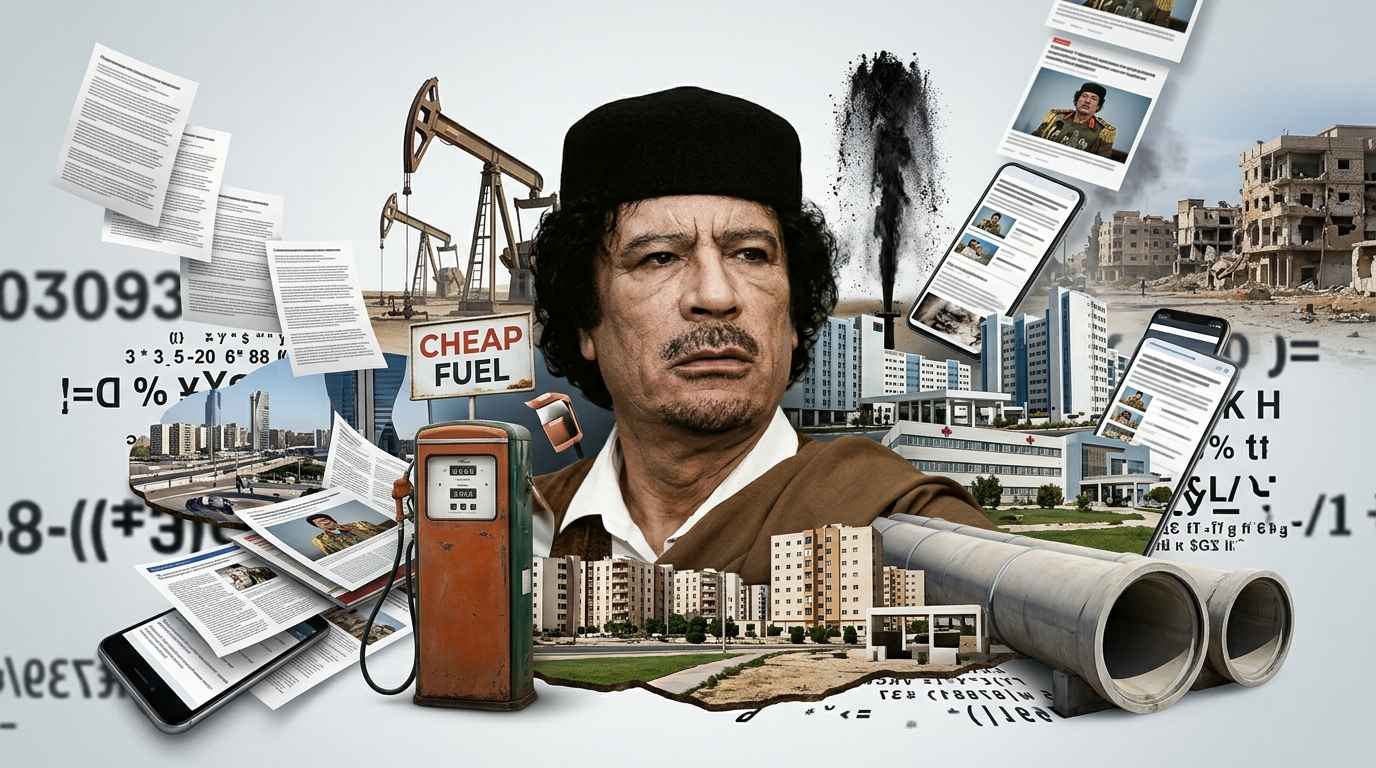
Claims that every newborn received $7,000, newlyweds were given $64,000, and housing was free under Muammar Gaddafi have circulated online for years. Some elements of the story are rooted in real social policies, while others lack reliable primary evidence. Yet the list helped create a lasting image of Libya under Gaddafi as a kind of social paradise — a narrative that eventually reached a global audience through Hollywood and one of the world’s most prominent podcasts.
The list began circulating while Gaddafi was still alive
There is a widespread assumption that the famous list appeared only after the 2011 war and Gaddafi’s death. Internet archives suggest otherwise.
One of the earliest documented Russian-language versions we found was published on March 25, 2011 — months before Gaddafi was killed. It already contained many of the claims that would later become part of the viral narrative: extremely cheap fuel, unemployment payments, nurses’ salaries, financial support for newborns, money for newlyweds and assistance for people starting businesses.
A very similar version was republished on October 29, 2011, just days after Gaddafi’s death, under the headline: “These are the ‘sins’ for which Gaddafi was killed.”
It is difficult to establish who originally wrote the list or where it first appeared. It would therefore be inaccurate to claim definitively that the story “originated in Runet.” What can be said with confidence is that some of the earliest documented versions were circulating in the Russian-speaking internet as early as March 2011.
Why does the list look so convincing?
The strength of the text lies in the fact that it mixes claims that sound sensational with facts that are broadly grounded in reality.
Libya under Gaddafi did have extremely low fuel prices. The state financed healthcare and education, while food and energy were heavily subsidized.
According to the World Bank, Libya had an extensive social protection system before the 2011 conflict. Healthcare and education were provided free of charge, food and fuel were heavily subsidized, and a large share of the population depended on the public sector for employment.
That means it would be wrong to dismiss every point in the viral list as simply “fake.” The real problem is that genuine social policies were mixed together with specific figures and claims that have no convincing primary-source documentation.
$7,000 for every newborn and $64,000 for newlyweds — was it real?
The viral list claims that every newborn received $7,000 and that newlyweds were given $64,000 to purchase a home.
These figures have been repeated across websites, blogs and social media posts for years. But the viral list itself does not cite an official government document proving that such payments were universally and automatically provided to all citizens.
There is another problem: the figures change from one version of the list to another.
Some versions claim that newborns received $5,000 rather than $7,000. The amount allegedly given to newlyweds also varies, with some versions citing $50,000 instead of $64,000.
That kind of variation is difficult to reconcile with the idea that the list is reproducing a single official government program.
It is therefore misleading to present these numbers as established facts — for example, by saying that every Libyan family automatically received $7,000 for each child or $64,000 upon marriage.
Where did the idea of “free housing for everyone” come from?
This is one of the most popular elements of the Gaddafi myth.
Different versions of the viral text claim that housing was free, that newlyweds received money to buy homes, and that the state provided housing to citizens.
Libya did have government housing programs and forms of social assistance. But the much stronger claim that every citizen automatically received a free home at a certain age is not supported by convincing primary evidence.
That distinction matters.
Government subsidies and housing programs are not the same thing as a universal system in which every citizen receives a free house.
What about the famously cheap gasoline?
Here, the viral narrative is based on a genuine fact.
Libya was a major oil producer, and fuel prices were heavily subsidized during Gaddafi’s rule. Gasoline was indeed extremely cheap by international standards.
The International Monetary Fund has documented Libya’s exceptionally low energy prices and extensive subsidies. In 2012, energy subsidies amounted to roughly 11% of GDP, with more than half of that amount going toward fuel subsidies.
So the claim that gasoline was extraordinarily cheap is not a fabrication.
The problem is that this genuine fact was later surrounded by a series of other claims whose evidence is much weaker.
Electricity was not literally free either
The viral list says Libyans did not have to pay for electricity.
Again, the reality was more complicated.
Electricity was heavily subsidized by the state, but that does not mean it had literally zero cost.
IMF data, for example, shows that the residential electricity tariff in 2012 was around 1.5 US cents per kilowatt-hour. The price was exceptionally low, but describing electricity as simply “free” removes important context.
“Large taxes were banned” is also misleading
The list claims that major taxes and levies were prohibited.
That is not an accurate description of Libya’s tax system.
An IMF report from 2010 described a tax reform that introduced a 10% rate for individuals and a 20% rate for corporations. Libya therefore had a functioning tax system; taxes had not simply been abolished.
Once again, the viral list takes a complicated reality and turns it into a simple slogan.
What does the list leave out?
The biggest weakness of the “golden Libya” narrative is what it chooses not to discuss.
The country’s social benefits existed alongside an authoritarian political system.
Human Rights Watch reported in 2011 that Libya continued to impose severe restrictions on freedom of expression and assembly. Independent civil society organizations faced major restrictions, while criticism of Gaddafi and the government could lead to repression.
When the 2011 uprising began, government forces responded with violence, arrests and disappearances, according to human rights organizations.
This does not erase Libya’s social achievements. But it demonstrates why the country cannot accurately be described solely as either a “social paradise” or a state with no meaningful social system.
But there were real achievements under Gaddafi
This part should not be ignored either.
Libya experienced major improvements in health and social indicators during the decades before 2011.
World Bank data shows that life expectancy rose from roughly 56 years in 1970 to around 72 years by 2010. Under-five mortality fell from 43 deaths per 1,000 live births in 1990 to 15 in 2012.
Those are significant improvements.
Gaddafi’s government also oversaw major infrastructure projects, including the Great Man-Made River, a huge system designed to transport groundwater from Libya’s southern aquifers toward the more heavily populated north.
So the issue is not whether Libya achieved anything under Gaddafi. It clearly did.
The issue is that genuine achievements were later combined with unverified or exaggerated claims and presented as one seamless story.
How did the narrative reach Hollywood?
This is perhaps the most interesting part of the story.
The narrative did not remain confined to Russian-language websites and social media. Over the years, similar claims entered the English-speaking information space.
In 2024, actor Russell Crowe discussed Libya and Gaddafi during an appearance on The Joe Rogan Experience.
Crowe said that people in Libya were given homes at a certain age, that education and healthcare were free, and that if someone demonstrated a particular talent and needed to study abroad, the government would cover the costs.
Crowe did not read out the 23-point Russian-language list word for word, and there is no evidence that he directly copied it. But several of the claims he mentioned closely overlap with the central ideas contained in the viral “golden Libya” narrative.
Rogan later repeated some of the same claims in other episodes, recalling Crowe’s description of free education, housing and government-funded education abroad.
This is how an idea that once circulated as an anonymous internet post can gradually enter mainstream conversations — and eventually be repeated by people with audiences far larger than the original websites that carried it.
The problem is not simply that people “believe lies”
It is tempting to explain misinformation by saying that people simply fail to check facts.
The reality is often more complicated.
The viral list is designed to look factual.
It contains dozens of specific numbers: the price of gasoline, the amount allegedly given to newborns, the supposed payment to newlyweds, unemployment benefits, salaries and business grants.
Specific numbers create an impression of authenticity.
A person sees the list online, believes it, and sends it to a friend. Someone else copies it into a blog. Another person turns it into a video. Eventually, the original source disappears — but the claims remain.
After enough repetitions, the information begins to feel like established historical knowledge.
Most people who spread such claims may not be deliberately creating misinformation. They are simply repeating something they themselves believe to be true.
That is how misinformation becomes self-sustaining.
“These are the sins for which Gaddafi was killed” is the most manipulative part
The title of the viral list reveals its central problem.
It takes a collection of social and economic claims and presents them as the explanation for a complex historical event.
On one side are cheap fuel, subsidies, free education and healthcare.
On the other are the 2011 uprising, the government crackdown, civil war and international military intervention.
Reducing all of those events to the idea that “Gaddafi was killed because he gave people too many benefits” is an enormous simplification of history.
It is also the most powerful propaganda element of the list.
The social policies may have existed. Some of them were genuinely significant. But that does not establish the causal claim implied by the headline.
Why has the myth survived for so long?
Because it contains elements of truth.
Fuel really was extremely cheap. Healthcare and education were publicly funded. Energy and food were heavily subsidized. Life expectancy increased, while child mortality fell.
But those real facts were placed alongside claims such as $7,000 per newborn, $64,000 for newlyweds, universal free housing, completely free electricity and the abolition of major taxes.
The result was a single, emotionally powerful narrative: Gaddafi created a country where citizens received everything from the state — and was therefore destroyed by foreign powers.
The list itself has changed over time. Numbers have been altered, details have appeared and disappeared, and different versions have circulated in different countries.
Yet the basic story remains the same.
That is one of the classic ways political myths survive on the internet.
Libya between reality and myth
The Libya of Gaddafi’s era cannot honestly be described as either a perfect “golden age” or a country with no social achievements.
It was an oil-rich, authoritarian state that used a large share of its resources to fund subsidies and public services. It developed significant social programs and infrastructure, while also maintaining severe political restrictions and relying heavily on the public sector.
There is solid evidence of improvements in Libya’s social indicators.
But those facts do not prove that Gaddafi was killed because of his welfare policies.
The famous “23 sins” list blurred the line between documented social policies, unverified numbers and political interpretation.
Years later, some of those claims continue to circulate as if they were established historical facts.
The story is therefore bigger than Gaddafi or Libya.
It is a demonstration of how misinformation works: real facts are mixed with unsupported claims, the mixture is repeated often enough to become familiar, and familiarity is eventually mistaken for truth.
Источник / Дереккөз / Source: Facts.kz