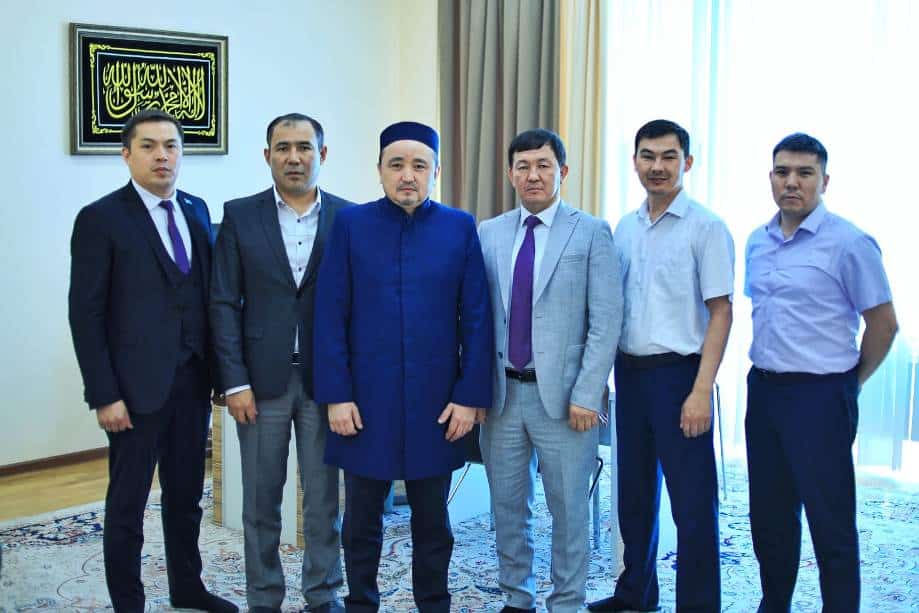
A meeting was held between representatives of the NCA and the Spiritual Administration of Muslims of Kazakhstan, at which the issue of the activities of the SAMK in terms of establishing spiritual, political and market mechanisms for the certification of processes for the production of Halal products and services was discussed.
Deputy General Director of NCA Absamat Akimov, Head of the Department of Methodology and Rationing Almat Oryngaliuly and Chief Specialist of the Department Dastan Moldybayev, Appraiser of the Department of Certification Bodies Baglan Kuttybayev during a meeting and conversation with Deputy Grand Mufti Yershat Ongar and Director of Halal Damu LLP Aibek Askarbekuly discussed the issue of increasing the status of the Muftiate to the authorized body on Halal issues, which oversees issues of a socio-political, educational nature in the field of Halal in the spiritual and religious aspect.
Today, under the Muftiate, the Halal Damu LLP operates, whose activities are related to the certification of Halal production and services.
However, the international standards Halal ST RK OIC / SMIIC-2 adopted in the Republic of Kazakhstan contain clear requirements for establishing standards for the authorized body on Halal issues.
In the case of Kazakhstan, it is appropriate to assign the role of such a body to the SAMK, in connection with which the representatives of the NCA outlined their vision for the Muftiyat to abandon certification activities and rise to the level of an authorized body that will determine strategies and policies regarding the regulation of Halal.
In this case, the Muftiate will be able to participate in the accreditation processes together with the NCA and send to the accreditation body persons who are technical experts in the field of Halal; will be able to take action against unscrupulous bodies for certification of production, services and organizations that violate Halal requirements.
Thus, the Halal area in Kazakhstan will expand from a relationship of trust based on religious community to the level of compliance with the requirements of food safety and quality management systems, sanitary, hygiene standards, personnel management, and so on, some of which have not always been taken into account until now.
– In this case, we will move to a more reliable Halal regulatory platform by applying the standards of the Institute of Standards and Metrology of Islamic Countries – SMIIC – which unites more than 50 states. Such a course of events and the establishment, application of such norms will make Halal the top of the entire quality chain, – says Almat Oryngaliuly. – For this reason, since the beginning of 2020, starting from the first meetings, the NCA has been insisting on strengthening the role of the SAMK as an authorized body on Halal issues. In this case, the issuance of certificates should become the exclusive prerogative of the subjects of market relations in order to free up the resources of the SAMK to promote the fulfillment of the requirements of Islam in relation to the production of Halal products and services.